Cash, accrual or none: how Fineract’s accounting options change what hits your books
The rule you pick on a product decides when income shows up, which accounts move, and whether the balance sheet matches the loan book. One dropdown. Years of living with it.
TECH247 LIMITED25 Sept 20269 min read
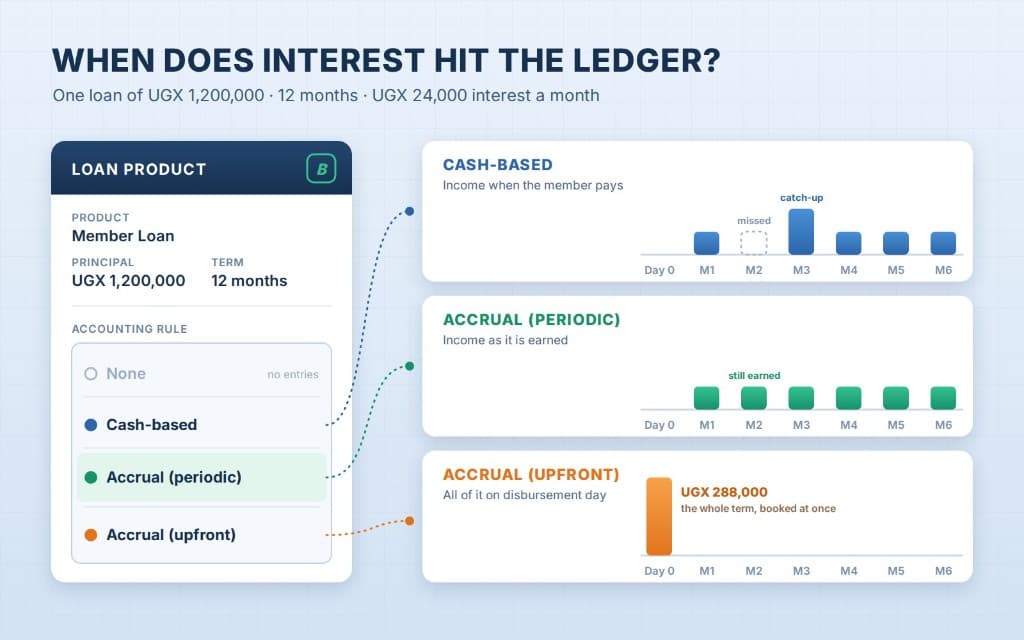
The accounting rule you pick on a product decides when income shows up in your books, which accounts move on every transaction, and whether your balance sheet matches your loan book at all. It is one dropdown on the product form. Most SACCOs pick it in a hurry during setup and live with the result for years.
This walks through each option Apache Fineract gives you, the journal entries each one produces for the same loan, and savings and shares too. When your accountant asks why interest income jumped at month-end, or why the GL does not match the portfolio report, you know where to look.
The four options
Fineract has four accounting rules. They differ on one question: when does income or expense hit the general ledger?
| Rule | When income is recognised | Extra GL accounts it needs | Available on |
|---|---|---|---|
| None | Never. No journal entries are posted | None | Loans, savings, deposits, shares |
| Cash-based | When the money is actually received or paid | None beyond the basics | Loans, savings, deposits, shares |
| Accrual (periodic) | As it is earned, day by day or at each run of the accrual job | Interest, fees and penalties receivable (plus interest payable on savings) | Loans; savings and deposits in recent Fineract releases |
| Accrual (upfront) | All of it on the day the loan is disbursed | Interest, fees and penalties receivable | Loans only |
The rule is set per product, not per institution. Your development loan can be on accrual while your emergency loan stays on cash. That flexibility is useful. It also means two products can tell two different stories in the same income statement.
Whatever rule you choose, Fineract asks you to map each role (fund source, loan portfolio, interest income and so on) to an account in your chart of accounts. Those mappings are what the rest of this post is about.
One loan, three sets of books
Take a member loan of UGX 1,200,000 over 12 months at a flat UGX 24,000 interest per month. Each instalment is UGX 124,000: 100,000 principal and 24,000 interest. Total interest over the term is UGX 288,000.
Disbursement
The principal entry is the same under every rule except None:
| Account | Debit (UGX) | Credit (UGX) |
|---|---|---|
| Loan portfolio (asset) | 1,200,000 | |
| Fund source (asset: cash, bank or mobile money) | 1,200,000 |
Upfront accrual adds a second entry on the same day. It books all the interest for the whole term:
| Account | Debit (UGX) | Credit (UGX) |
|---|---|---|
| Interest receivable (asset) | 288,000 | |
| Income from interest (income) | 288,000 |
One disbursement, and your income statement already shows 288,000 of interest you have not collected.
Month 1: the member pays on time
Cash-based posts one entry when the money arrives:
| Account | Debit (UGX) | Credit (UGX) |
|---|---|---|
| Fund source | 124,000 | |
| Loan portfolio | 100,000 | |
| Income from interest | 24,000 |
Periodic accrual posts twice. First the accrual job recognises interest as it is earned during the month:
| Account | Debit (UGX) | Credit (UGX) |
|---|---|---|
| Interest receivable | 24,000 | |
| Income from interest | 24,000 |
Then the repayment clears the receivable instead of touching income:
| Account | Debit (UGX) | Credit (UGX) |
|---|---|---|
| Fund source | 124,000 | |
| Loan portfolio | 100,000 | |
| Interest receivable | 24,000 |
Upfront accrual posts only the repayment entry above. The income was already booked at disbursement.
Month 2: the member misses the instalment
This is where the rules really differ.
| Rule | What posts in month 2 | Interest income in month 2 |
|---|---|---|
| Cash-based | Nothing | UGX 0 |
| Periodic accrual | The accrual entry, as in month 1. Interest receivable grows to 24,000 unpaid | UGX 24,000 |
| Upfront accrual | Nothing new. The 24,000 stays inside the 288,000 booked on day one | UGX 0 this month (all booked in month 0) |
Cash-based under-reports what you have earned. Periodic accrual reports what you have earned, collected or not. That is why your PAR report and your interest receivable balance should always be read together.
Month 7: the loan is written off
Say six instalments were paid and UGX 600,000 of principal is outstanding.
- Cash-based: debit Losses written off 600,000, credit Loan portfolio 600,000. No interest was ever booked, so there is nothing more to reverse.
- Periodic accrual: the same principal entry, plus any accrued but unpaid interest leaves Interest receivable and goes to Losses written off.
- Upfront accrual: the same, but the unpaid receivable can be much larger: up to the 144,000 of interest for the six months never collected.
The interest you booked early does not go away. It comes back as a loss on the day you give up on the loan.
Savings and fixed deposits
On savings, the question is when you recognise the interest you owe members, not the interest you earn. A member deposit is a liability: money you hold on the member’s behalf.
| Transaction | Debit | Credit |
|---|---|---|
| Deposit of UGX 500,000 | Savings reference (asset) | Savings control (liability) |
| Withdrawal | Savings control | Savings reference |
| Monthly fee charged to the account | Savings control | Income from fees |
| Interest posted to the member, cash-based | Interest on savings (expense) | Savings control |
Under cash-based, the interest expense appears only on the day interest is posted to member accounts. If you post quarterly, three months of cost land in one month.
Periodic accrual on savings, fixed and recurring deposits spreads that cost. The accrual job books the interest as it builds up, into an Interest payable liability. When interest is posted, it moves from Interest payable to the member’s balance:
| Step | Debit | Credit |
|---|---|---|
| Accrual as interest builds up | Interest on savings | Interest payable (liability) |
| Interest posted to the member | Interest payable | Savings control |
Fees and penalties can go through Fees receivable and Penalties receivable in the same way. Savings accrual arrived in recent Fineract releases, so check your version before you plan on it.
If you allow overdrafts, two more mappings matter: Overdraft portfolio (asset) grows when a member goes below zero, and overdraft interest goes to Income from interest.
Shares
Share products offer only None or Cash-based. There is no accrual, because share capital earns no interest. The main thing to know is the suspense step: a purchase is held pending until someone approves it.
| Step | Debit | Credit |
|---|---|---|
| Member buys shares (pending) | Share reference (asset) | Share suspense (liability) |
| Purchase approved | Share suspense | Share equity (equity) |
| Purchase rejected | Share suspense | Share reference |
| Share fee charged | Share reference | Income from fees |
While a purchase is pending, the money is a liability, not capital. Your balance sheet only shows it as equity once it is approved. That matches how most SACCO bylaws treat an application that has not yet gone through.
If you have been running shares as a savings product with a different name, this is the reason to stop. We cover that in Shares vs savings.
Advanced accounting rules
The basic mapping sends every repayment to one Fund source account. That is rarely how a SACCO actually takes in money. Advanced accounting rules on loan and savings products fix this in three ways:
- Payment type to fund source. Cash goes to Cash at hand, bank transfers to your bank account, MTN MoMo to the MTN float account, Airtel Money to the Airtel float account. Your mobile money float in the GL then matches your telco statement, which makes daily reconciliation possible. We covered why that matters in Reconciling mobile money.
- Fee to income account. Loan processing fees, ledger fees and insurance each go to their own income line instead of one “Income from fees” total.
- Penalty to income account. Late-payment penalties can be tracked apart from other penalties.
Newer Fineract versions also add mappings for charge-offs (with a separate expense account for fraud), goodwill credits and recoveries. If you write off loans often, map Income from recovery repayments. Money recovered after a write-off then shows as recovery, not as new interest income.
None of this changes when income is recognised. It changes which account the entry lands in, which is what your board pack and your regulator returns are built from.
Which one should you pick?
For most SACCOs we start with cash-based on savings and shares, and a choice between cash and periodic accrual on loans.
| Your situation | Loans | Savings and deposits |
|---|---|---|
| Savings group or small SACCO, simple books, no audited IFRS statements | Cash-based | Cash-based |
| Growing SACCO or MFI with audited accounts and a board that reads monthly income | Periodic accrual | Cash-based, or periodic accrual if your version supports it and interest is material |
| Short loans of a month or less, one repayment | Upfront accrual can work, since income and collection fall in the same month | Cash-based |
| Your books are kept in another accounting system | None, only with a firm plan to sync | None |
A few things to settle before go-live:
- Avoid None unless the GL lives somewhere else. With None, Fineract tracks every balance but posts no journal entries. Your trial balance is empty and the board pack goes back to Excel.
- Accrual needs the nightly jobs running. Periodic accrual depends on the scheduler jobs that post accruals. If they stop, income stops too, quietly. See What actually happens in a Fineract end-of-day run.
- Decide once. Changing the rule on a live product does not restate what was already posted. Accounts opened before and after the change will sit on different bases.
- Read income next to PAR. Under accrual, rising interest income with rising PAR usually means income you may never collect.
- Map before you migrate. Opening balances from your old system should land in the same GL accounts the products are mapped to. If they don’t, the portfolio report and the balance sheet will never agree.
If you are setting up Fineract, or already run it and the GL does not match the loan book, tell us how the products are mapped today. Checking product accounting is usually the first thing we do.