Same balance, different days: why closing-balance interest shortchanges your earliest savers
Splitting the year's interest by closing balance pays a member who saved in December the same as one who saved in January. Daily-balance interest fixes that, and it is how the bonds themselves pay.
TECH247 LIMITED9 Nov 20265 min read
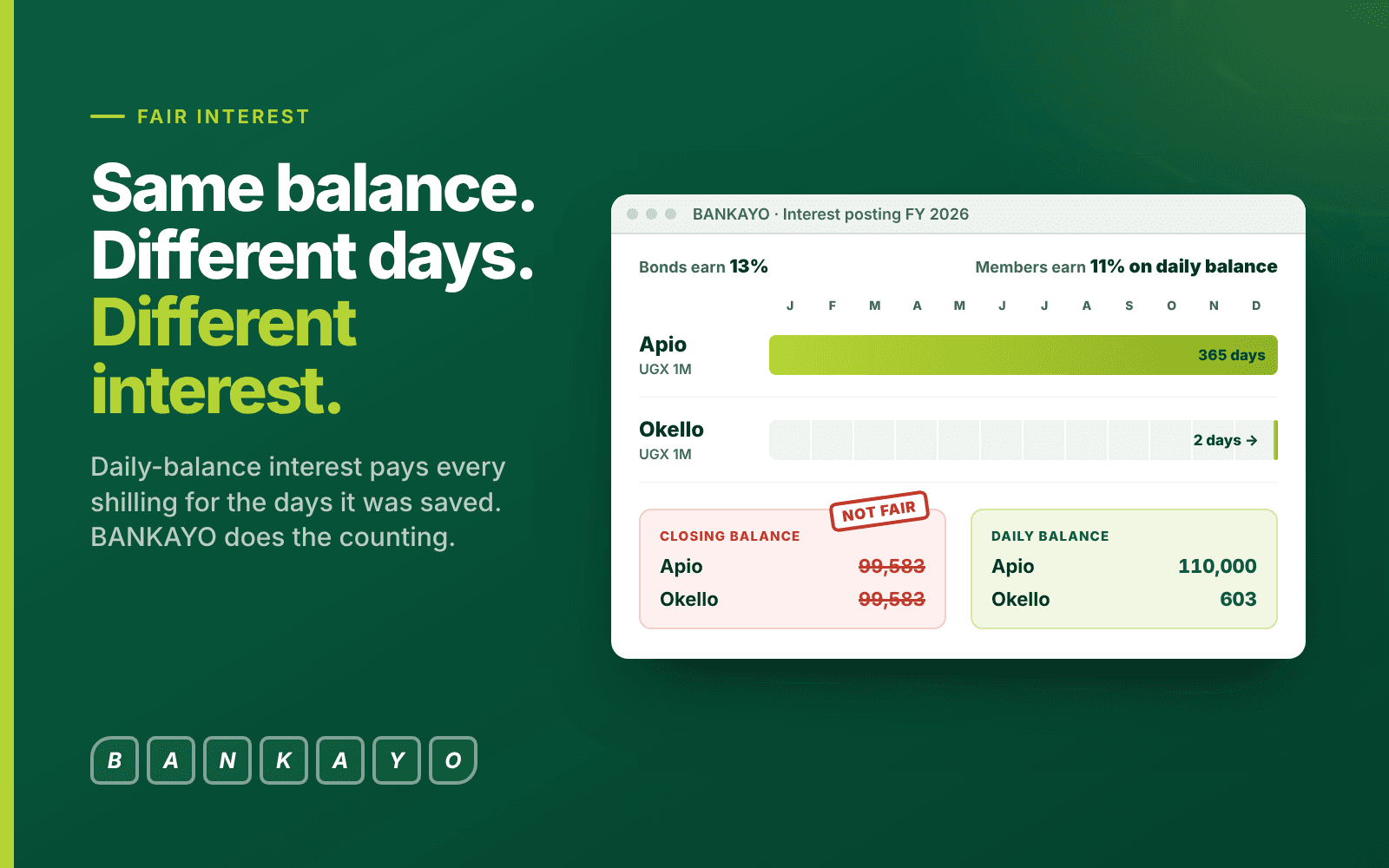
Interest is a payment for time. The bond pays the club for every day the money is invested. Many clubs then share that interest out as if time did not matter.
A lot of investment clubs do not issue shares. Members save, the club puts the savings into treasury bonds, unit trusts or a fixed deposit, and at the end of the year the interest is shared out. In most clubs the sharing sheet has one formula in it: each member's closing balance as a share of the total. It is simple, it adds up, and it pays the wrong people.
The closing balance looks at one day
When the treasurer divides the year's interest by closing balances, the club is looking at 31 December and ignoring the other 364 days. That gets things wrong in both directions:
- A member who deposits UGX 1,000,000 the day before closing earns the same as a member whose 1,000,000 was invested since January. The first member's money never reached a bond.
- A member who saves a little every month is treated as if the full balance had been there all year, which overpays them at the expense of members who saved early.
- A member who withdraws in October is paid as if the money they took out was never there, even though it earned interest for the club for nine months.
Members notice. The late depositor becomes a strategy: top up in December, collect a full year's interest, withdraw in January. Every shilling that strategy collects comes out of the pockets of the members who were patient.
(If your club does issue shares, the same problem shows up in dividends. We covered it in Same shares, different months.)
Do what the bond does
The fix is already in the instrument the club holds. A treasury bond does not pay on its closing balance. It earns interest every day on the amount invested that day.
So the club should do the same for its members: work out interest on each member's daily balance, add it up across the year, and pay it at year end. A shilling that was in the club for 365 days earns 365 days of interest. A shilling that arrived on 30 December earns two days.
Clubs that run this way usually set the members' rate slightly below what the bonds pay. The bonds might earn 13% a year; the club pays members 11%. The difference covers the club's costs, such as bank charges, the custodian fee and the AGM, and the members know the rate before the year starts instead of finding out what is left over at the end.
A worked example
A small investment club invests its members' savings in a treasury bond earning 13% a year. The club pays members 11% a year on their daily balance, and shares the interest out once, at year end.
Four members each start or finish the year with savings in the club:
| Member | Savings activity | Closing balance (UGX) | Closing-balance share (UGX) | Daily-balance interest at 11% (UGX) |
|---|---|---|---|---|
| Apio | 1,000,000 on 1 Jan | 1,000,000 | 99,583 | 110,000 |
| Nakato | 600,000 on 1 Jan, 400,000 on 1 Jul | 1,000,000 | 99,583 | 88,181 |
| Mugisha | 1,000,000 on 1 Jan, withdrew 500,000 on 1 Oct | 500,000 | 49,792 | 96,137 |
| Okello | 1,000,000 on 30 Dec | 1,000,000 | 99,583 | 603 |
| Total | 3,500,000 | 348,541 | 294,921 |
Over the year the money the members actually had in the club earned the bond UGX 348,542. Under the closing-balance method, the treasurer divides that by 3,500,000 and pays each 1,000,000 the same 99,583 and the 500,000 half that. (The four shares add to 348,541; the last shilling is lost to rounding.)
Under daily balance, each day's balance earns 11% ÷ 365. Apio's 1,000,000 was there all 365 days, so she earns 1,000,000 × 11% = 110,000. Okello's was there for two days, so he earns 1,000,000 × 11% × 2 ÷ 365 = 603.
Look at what the closing balance did:
- Okello collected 99,583 for money that was in the club for two days. Daily balance pays him 603.
- Apio was paid 99,583 for a full year of savings. That is less than the 11% rate the club would have offered her, because her interest was shared with Okello.
- Mugisha funded the club for nine months and then withdrew half. The closing balance paid him 49,792. Daily balance pays him 96,137, nearly double.
- Nakato and Apio both finish on 1,000,000. Daily balance tells them apart; the closing balance cannot.
The club also keeps UGX 53,621, the gap between 13% and 11% on the money that was actually invested, to cover its expenses. It knew that margin in January, not after the sharing sheet was done.
Why clubs stay with the closing balance
Nobody picks the unfair method on purpose. They pick the one a spreadsheet can do in an evening.
To work on daily balances in Excel you need every deposit and withdrawal with its exact date, a running balance for each member, the number of days each balance was held, and the interest on each of those slices. A member who saves weekly has fifty-two rows. One deposit keyed with the wrong date, and the totals stop agreeing. So the club "keeps it simple", and the simple version quietly pays the December depositors. We wrote about this pattern in The spreadsheet ceiling.
How BANKAYO does it
In BANKAYO, every deposit and withdrawal is a dated transaction on the member's savings account. The account knows its balance on every day of the year, not just on 31 December.
You set up the club's savings product once:
- Set the annual rate you will pay members, a little below what your bonds or deposits earn.
- Calculate on daily balance, with a 365-day year, so each member earns on their actual balance for each day, just as the bond accrues for the club. The deposit day counts, and a withdrawal stops earning on the day it leaves.
- Compound and post once a year, at year end, to every member's account in one run. Keeping compounding annual is what makes a full year at 11% pay exactly 11%. Daily compounding on the same rate would pay Apio about 116,260 instead of 110,000.
There is no sharing sheet to build and no formula to copy down. A December top-up earns December's interest and nothing more, and a withdrawal stops earning on the day it leaves. If a cash deposit or withdrawal was keyed on the wrong date, you correct the date and the next interest calculation uses it. Each member's statement shows their deposits, withdrawals and the year's interest posting.
It suits any club whose money sits in treasury bonds, unit trusts or similar instruments that earn interest every day.
If your club still shares interest by closing balance, send us last year's sharing sheet. We will show you what it looks like on daily balances, and which members were paid for days their money was not there.